Micro LED Innovations: From Smart Wearables to Data Transmission, Shaping the Next Visual Frontier

Link copied!

Micro LED is redefining the future of display and optical communication technologies.


With continuous advances in chip design, materials, and process integration, Ennostar is accelerating the transition of Micro LED from concept to commercialization—expanding its role across smart wearables, automotive displays, AI devices, and even high-speed optical data communication. This article outlines key technology developments including:

 1.The core advantages of Micro LED
 2.The challenge and breakthrough of red Micro LED performance
 3.The innovative GemiLED™ platform
 4.Micro LED’s emerging role in optical data communication
 

1. Why Is Micro LED Considered the Future of Display Technology?


Micro LED is widely regarded as a next-generation display solution due to its exceptional brightness, high contrast ratio, long lifetime, and low power consumption.


Its design flexibility—supported by free-form shapes and ultra-wide viewing angles—enables new display formats such as transparent panels, flexible surfaces, and seamless modular displays.


With ultra-high resolution and rapid response speed, Micro LED delivers outstanding image clarity. Its strong thermal stability further supports demanding use cases.


Micro LED applications have expanded rapidly. 

In consumer electronics, Micro LED is now used in products ranging from Garmin smartwatches to Samsung’s large-format displays. In XR and AI wearables, the TCL Thunderbird RayNeo X3 Pro—powered by a Micro LED optical engine and waveguide technology—was named “Best of CES 2025.”


In automotive environments, Micro LED enables next-generation design concepts such as flexible center consoles, virtual sky canopies, foldable driving displays, and XR-enabled interactive windows.
2. Why Has Red Micro LED Been a Long-Standing Challenge—and How Has It Been Overcome?


紅光 Micro LED 結構圖
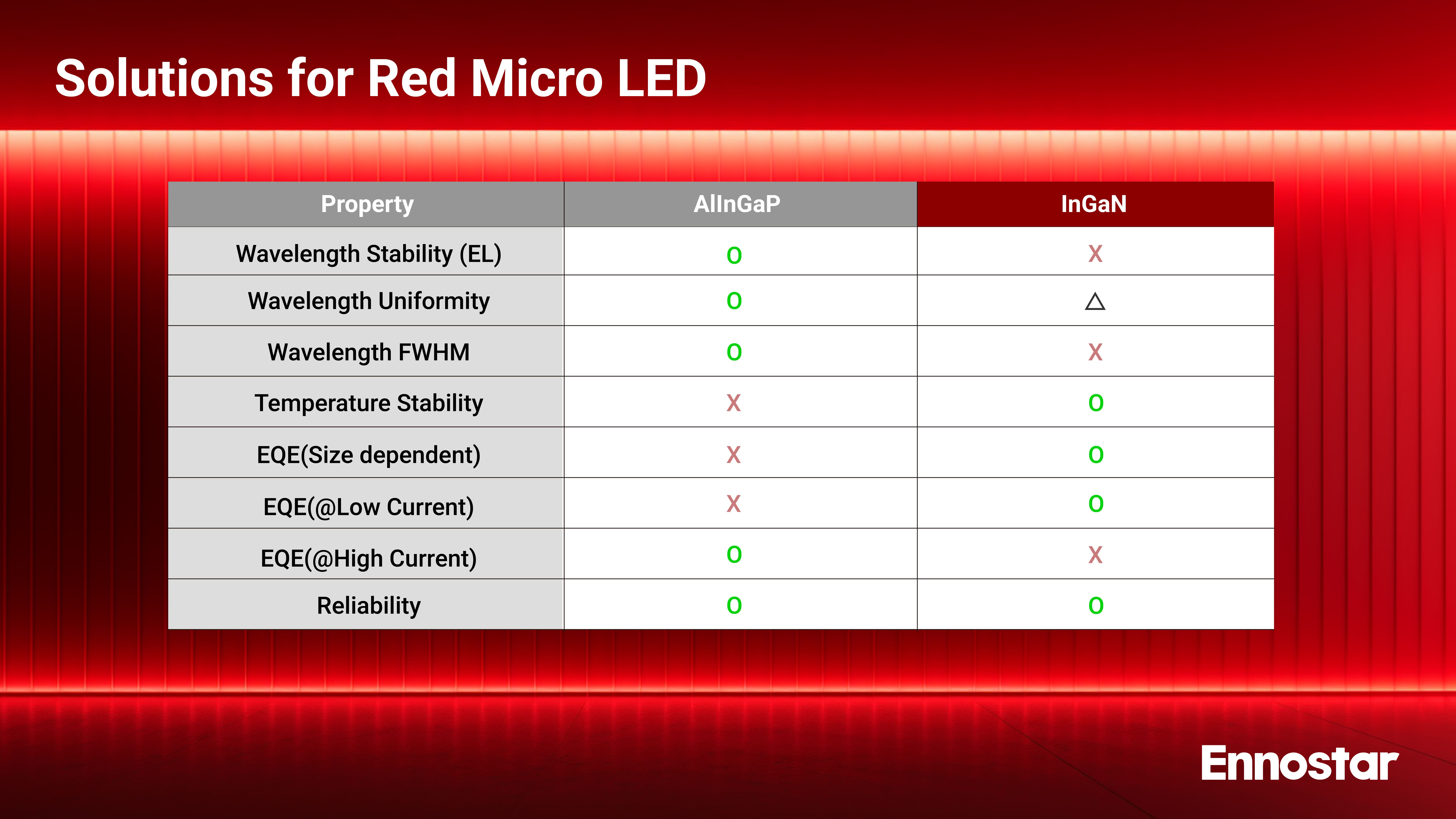
Solutions for Red MicroLED


Red Micro LED is essential for full-color displays, yet historically suffers from lower efficiency and stability than blue and green chips.


Key limitations include:

• Higher drive current requirements, increasing system power consumption

• Larger chip size, affecting cost and transfer complexity.

• Thermal degradation at elevated temperatures.


Ennostar’s research team addressed these challenges through three key advances:

1. Enhanced light extraction using refined surface texturing.

2. Optimized current spreading, delivering 15–17% luminance improvement.

3. Material innovation, with the development of InGaN-based red Micro LED offering better thermal stability and higher efficiency under low current density than traditional AlInGaP

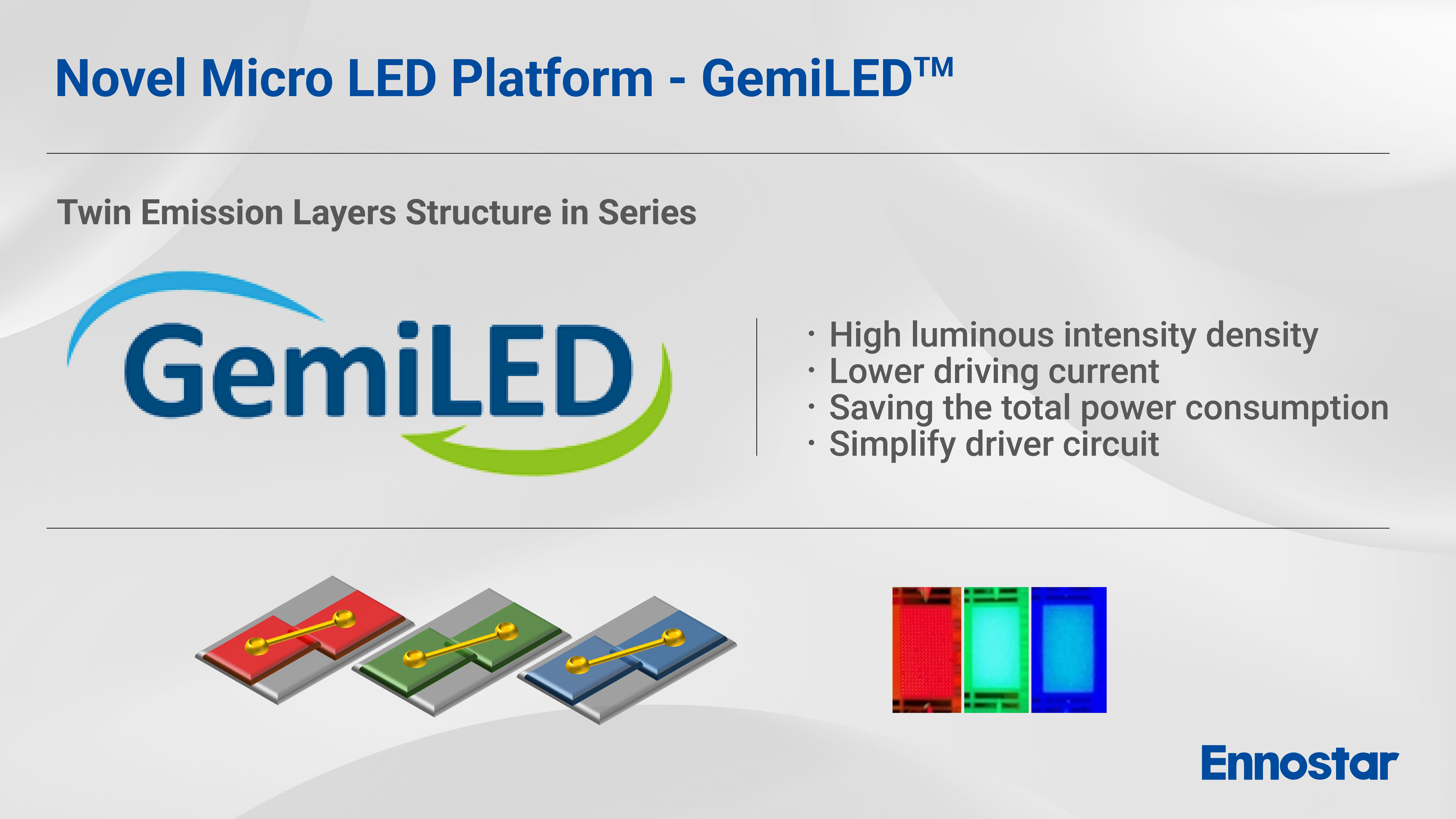
3. What Makes GemiLED™ a Breakthrough for High-Efficiency Micro LED?
GemiLED
Ennostar Novel MicroLED Platform-GemiLED


GemiLED™ is Ennostar’s advanced Micro LED platform featuring a twin emission layers structure in series.
This architecture enables each pixel to deliver higher light output at lower power.


Performance improvements include:

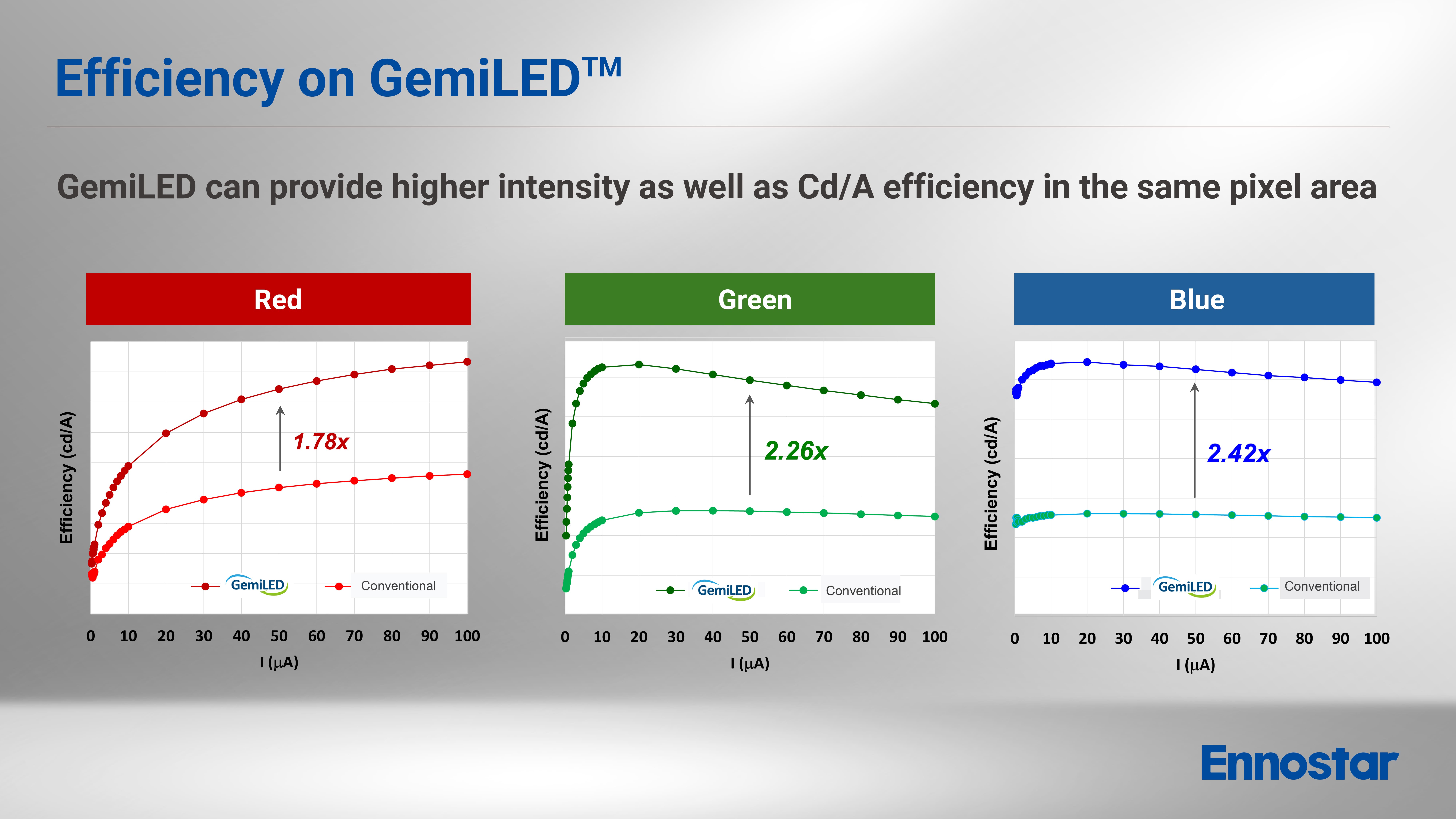
1.78× higher intensity and 2.26× higher efficiency for red chips.

2.42× efficiency improvement for blue chips.

~40% reduction in drive current at equivalent brightness.


This high-efficiency platform reduces power usage, improves thermal performance, simplifies drive circuitry, and enhances reliability across applications including automotive displays and smart watch displays.


Efficiency on GemiLED


4. How Is Micro LED Expanding into Optical Data Communication?
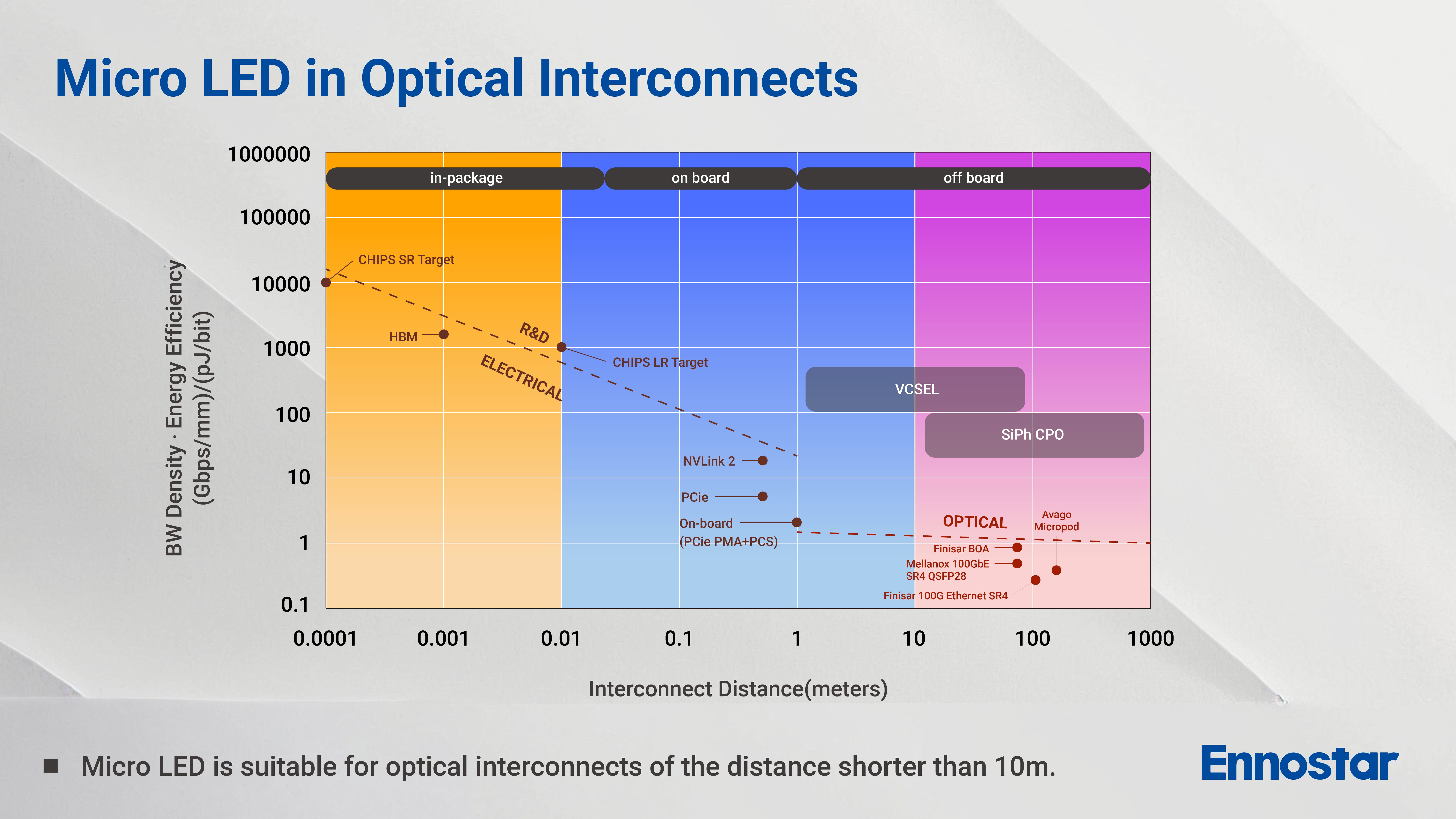
MicroLED in Optical Interconnects


While commonly associated with premium displays, Micro LED is emerging as a strong candidate for optical communication—particularly for short-reach chip-to-chip (C2C) links in AI servers and data-center systems.


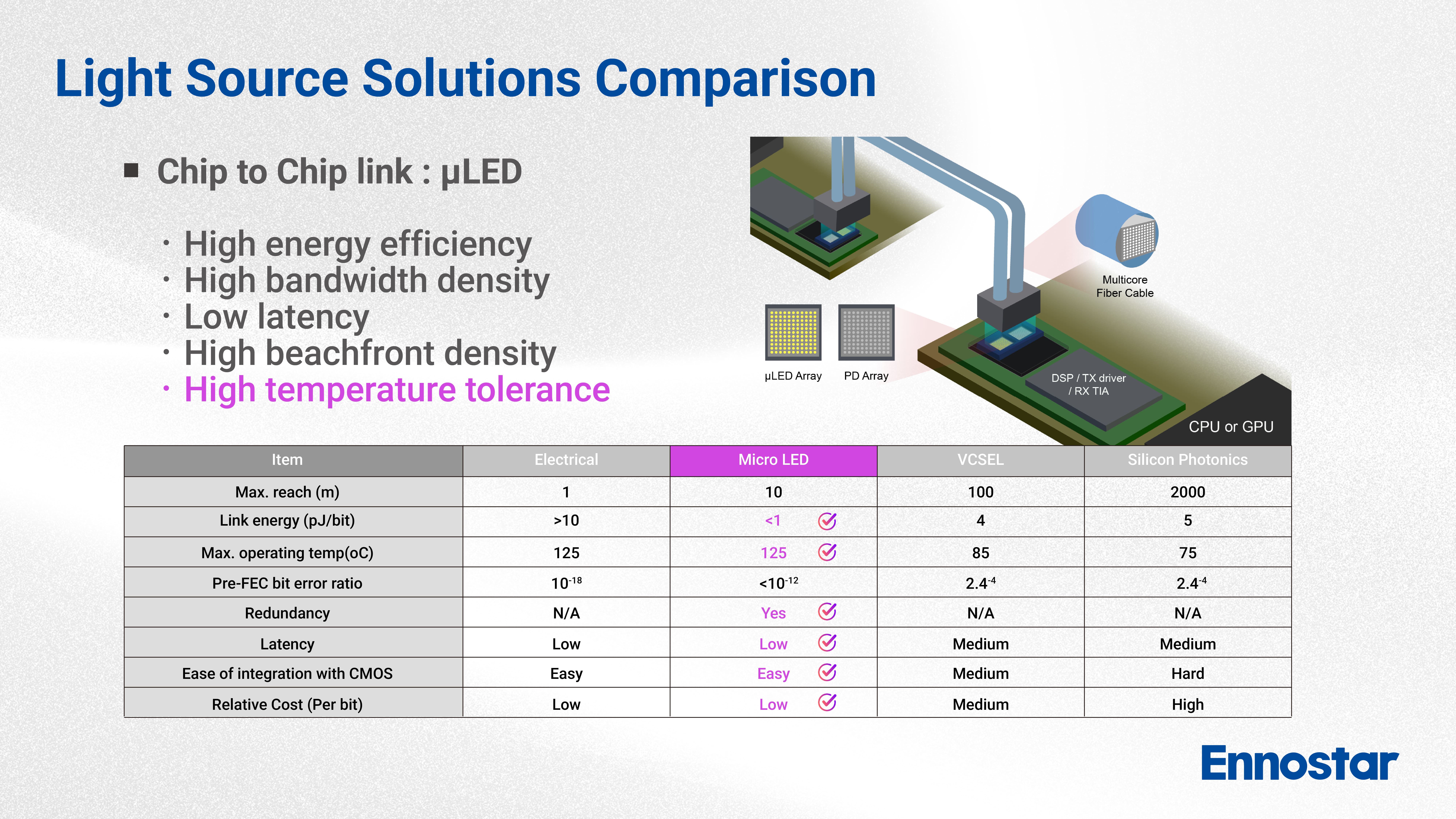
Compared with electrical signaling and VCSEL-based solutions, Micro LED provides:

Lower energy per bit, achieving below 1 pJ/bit.

Higher bandwidth density and lower latency.

Excellent thermal robustness, operating reliably up to 125°C.


Recent measurements show blue Micro LED achieving >1.8 GHz 3dB bandwidth at 2 kA/cm² after sapphire removal.


In early 2025, Ennostar showcased a compact Micro LED matrix light engine (1.6 × 1.6 × 0.1 mm) using RDL technology, delivering >800 MHz 3dB bandwidth and confirming its suitability for high-speed optical data transmission.


Light Source Solutions
Light Source Solutions Comparison


Conclusion: Why Is Micro LED Becoming a Core Technology for Displays and Communication?

From breakthroughs in red Micro LED performance to the high-efficiency GemiLED™ platform, Micro LED continues to push the boundaries of what is possible in optoelectronics.
These innovations not only enhance display quality but also unlock new opportunities in optical data communication and intelligent systems.


For Ennostar, Micro LED is more than a display advancement. It's a foundational technology enabling the next generation of optoelectronic solutions.